


Go Ski Touring SAFELY
Tips and advice for your safety on the mountain
Alongside the mountain experience itself, safety is the highest priority. This means following key rules of conduct, heeding all guidance and instructions, planning your route carefully, and ensuring you have the right equipment.
Tip
Important: Current avalanche situation report Tyrol
Here you will find all information on avalanche danger levels, snowpack structure, danger patterns, trends, alpine weather reports and much more.
Staying Safe on Piste Routes
Attention at the start of the season!
The cable car operators must prepare the pistes before the expected start of the winter season and impose corresponding closures. Special care must also be taken on the other pistes: Until the start of skiing operations, "piste tours" are equivalent to ski tours in open terrain in terms of potential danger. Use is at your own risk, as danger spots are not secured and avalanches can occur as in open terrain.
Ski area is "out of service"
Ski Area "Out of Service"
When a ski area is “out of operation” or officially “closed”, all pistes are considered open terrain. Winter sports enthusiasts use them at their own risk, unless the piste has been explicitly closed by the operator for safety reasons. The piste operator may close runs at any time due to safety concerns or for grooming work.
Please note that ski tours in areas that are out of operation involve particular risks. These include hazards that you are unlikely to encounter when touring on open pistes during regular operating hours.
Anyone choosing to use a piste in a closed ski area does so at their own risk and, for their own safety, should adopt a cautious, defensive approach when skiing downhill.
Piste is closed
If a ski area is "out of operation", this means that there is no piste preparation and no protection against avalanches and other hazards. Strictly speaking, there are therefore no "piste tours" as we know them until the ski areas open. The following points must be taken into account when planning a tour:
Avalanche danger:
Even in ski areas where nobody normally thinks about avalanches, an avalanche on the piste cannot be ruled out before the ski area opens. We would like to point out that the standard equipment for ski tours (avalanche transceiver, probe, shovel) is definitely required before the start of the season, even for piste tours. If avalanche safety measures (e.g. avalanche blasting) are carried out in ski areas, we urge you to respect the barriers for your own safety.
Technical dangers:
Bear in mind the possibility of open snowmaking pipes and snow cannons that are almost covered in snow.
Securing Hazardous Areas:
In closed ski areas, you cannot assume that the piste continues safely beyond the next ridge. Tracks left by snow groomers or individual groomed sections do not guarantee that the entire piste is prepared or secured. You are in open terrain and proceed at your own risk.
Safe on piste ski tours

Piste tours: Stay on track! Bergwelt Tirol - Experience together
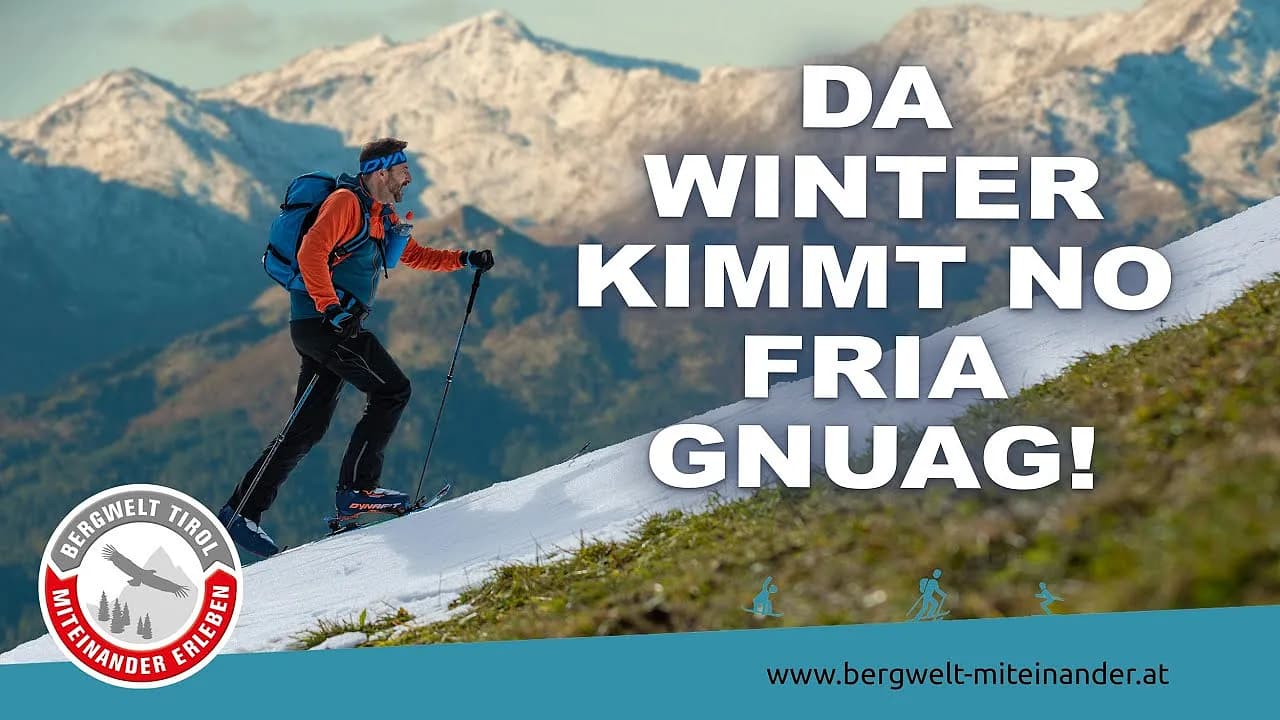

Pistes may be closed due to life-threatening dangers such as winch-assisted grooming or avalanche blasting.
A closed piste means danger to life!
When grooming work is underway, pistes are closed and clearly marked with warning signs. These closures are in place for your own safety and must be strictly observed.
Watch out before the ski resorts open!
The cable car operators must prepare the pistes before the expected start of the winter season and impose corresponding closures. Special care must also be taken on the other pistes: Until the start of skiing operations, "piste tours" are equivalent to ski tours in open terrain in terms of potential danger. Use is at your own risk, as danger spots are not secured and avalanches can occur as in open terrain.
Invisible danger!
Natural English Translator said:You won’t spot a snow groomer anywhere nearby – it’s hard at work on two steep slopes further down. Yet just a few hundred metres above, the high-tech machine is anchored in place by a thin steel cable. With its fully automatic onboard winch, even the steepest pistes can be groomed to the highest standard.
But this winch cable poses a serious risk to ski tourers. Due to its length and the shape of the terrain, the cable may be stretched taut above the ground like a tripwire or lie concealed beneath the snow – either way, it’s nearly impossible for winter sports enthusiasts to detect, especially in the dark.
Sudden changes in the direction of pull can cause the cable to lash sideways through the air for up to 100 metres – a life-threatening hazard for anyone within this hard-to-see danger zone.
Evening piste tours
Several ski resorts offer a special service for piste tourers: On some evenings, piste grooming starts later in order to enable a safe ascent after the regular piste operation.
Don't be a traffic obstruction!
Compared to the speed of a downhill run on skis or a snowboard, even the fastest climbers in skintight racing suits and speed skins are virtually motionless. So the often-cited comparisons with “ghost skiers on the piste” are greatly exaggerated. Downhill skiers who follow the FIS guideline “Every skier must ski in control and be able to stop or avoid other people” will not collide with uphill ski tourers.
BUT: Other “stationary” obstacles – like snow cannons or piste markers – are always positioned right on the edge of the piste wherever possible. If they can’t be avoided, they are clearly marked and secured, much like a warning triangle on the road: think of the orange impact protectors on lift pylons, or skis planted in the snow above an accident scene.
For this reason, ski tourers should also make it second nature to keep to the very edge of the piste. This simple step can greatly reduce the risk of collisions – especially in narrow sections, on bends, and in areas with limited visibility.
Observe the signposting!
In areas with a piste tour guidance system, the ideal ascent route was determined by professionals. In doing so, piste crossings have been reduced to a minimum, while at the same time ensuring that the route is as comfortable as possible. Please observe these signs - this is how we create a conflict-free and accident-free coexistence!
What must be observed when crossing?
With careful and well-planned route selection on the ascent, most piste crossings can be avoided. However, in some cases a crossing is still necessary – for example, when taking a turn-off towards the intended tour destination. In such situations, the following points are crucial:
- If available, follow the signposting for ski tourers!
- Never cross in front of blind spots such as crests or tight bends! This is where the risk of collision with downhill skiers is greatest.
- Cross the piste quickly and with plenty of space between each other. This leaves enough space for downhill skiers.
- Use flat sections for crossings! Crossings on steep slopes is technically very difficult and strenuous, especially on hard artificial snow.
- Don't forget: Once you've taken off your skins, you become a downhill skier yourself. By then at the latest, careless crossing manoeuvres will annoy and endanger you too!
Guidance system for piste tours
Tyrol has had its own guidance system for piste tours since 2016. "Safe & Fair" - that is the primary goal of the campaign. Those who adhere to the signage minimise the risk of collisions and support efforts to ensure conflict-free coexistence between lift users and ski tourers.
Overnight frozen tracks impair the quality of the piste.
Ski resorts invest considerable time and money in grooming. A perfectly prepared surface with its characteristic grooves plays a major role in ensuring enjoyable skiing the next morning. But if the piste is skied on at night, the resulting tracks freeze solid. Just like tram tracks can pose problems for cyclists, these frozen ski tracks can be hazardous – especially for narrow children’s skis. The issue is particularly common in late winter, when soft evening snow freezes overnight under clear, starry skies.
Closed piste means danger to life!
If grooming work is being carried out, pistes are closed and warning signs are put up. These closures must be observed for your own safety!
Use a lamp and reflective clothing in the dark.
Evening piste tours only on pistes open for this purpose!
The pistes are usually groomed in the evening and at night. This results in life-threatening dangers, especially from winch ropes. To make it possible to "burn off energy" on a piste tour after a long day at work, there is a special offer: in the spirit of "Safe & Fair", some pistes are not groomed until later and can be used by ski tourers beforehand.
Bright heads are visible
Natural English Translator said:For your own safety, make sure you remain visible when taking part in authorised evening ski tours. Headlamps and reflective clothing improve both how well you can see and how well you can be seen – helping to prevent accidents.
In the worst-case scenario, if something does happen, a torch can be used to signal an alpine emergency. Lights and reflective clothing also help rescue teams locate accident victims more quickly.
Ascent tracks for piste tourers
Dedicated ascent tracks for piste tourers serve to ensure safety and to separate the flow of skiers. In 2016, the Tyrolean piste touring guidance system developed a standardised nationwide signage system with orange "piste touring signs" to signpost the ascent tracks and guide piste tourers. They provide information about the difficulty, the distance to be covered and metres in altitude and also leave space for the logo of the piste operator or sponsor.
There are many good reasons not to take dogs on the piste - especially if you care about the well-being of your own four-legged friend!
- Danger of falling for downhill skiers. Free-roaming dogs are an unexpected and usually unpredictable obstacle on the piste. Collisions and falls due to wild evasive manoeuvres are inevitable.
- Dog leads usually don't make things any better. Long dog leads are of course taboo on a piste - keyword "trip wire". However, using a short lead takes a lot of practice. Your own sharp ski edges can come dangerously close to the dog's legs, especially on the descent.
- Dogs can become frightened. Skiers skiing loudly, quickly and close to the dog can easily lead to a reflex defence reaction from the dog...
- People can be frightened. Not everyone loves dogs. Many people are afraid and therefore have little understanding for "piste dogs". This inevitably leads to conflicts.
- High strain on dogs' joints. Skiing or snowboarding is easy on your own joints as you glide down into the valley. The opposite is true for your four-legged companion: they have to "gallop" downhill in the fall line to avoid losing their connection - and that over many hundreds of metres in altitude!
Only park in designated car parks and pay any parking fees.
FIS rules
- Show consideration: Skiers must always behave in such a way that nobody is endangered or harmed.
- Control of speed and skiing style: Skiers must ski by sight. They must also adapt their speed and skiing style to their individual ability and the terrain, snow and weather conditions as well as the density of traffic.
- Choice of lane: Skiers coming from behind must choose their lane in such a way that skiers in front of them are not endangered.
- Overtaking: You may overtake from above or below, from the right or left, but always at a distance that leaves the overtaken skier or snowboarder enough room to move.
- Entering, starting and travelling uphill: All skiers who want to enter a descent, start again after a stop or turn/ride uphill must make sure that they can do so without endangering themselves or others.
- Stopping: Every skier must avoid stopping in narrow or unclear places on a descent without need. A skier who has fallen must clear such a place as quickly as possible.
- Ascent and descent: Skiers ascending or descending on foot must use the edge of the downhill run.
- Observe the signs: All skiers must observe the markings and signals.
- Behaviour in the event of accidents: Everyone is obliged to provide assistance in the event of an accident.
- Compulsory identification: In the event of an accident, skiers must provide their personal details - whether they are a witness or a participant, whether they are responsible or not.

Easy piste tour
Up to 20 % (approx. 11°) average gradient in the longitudinal profile of the ascent track,
Up to 25 % (approx. 14°) maximum gradient in the longitudinal profile with the exception of short, slightly steeper
sections,
Up to 50 % (approx. 27°) slope gradient,
All changes of direction are easily possible in bends.

Medium-difficulty piste tour
Up to 30 % (approx. 17°) average gradient in the longitudinal profile of the ascent track,
Up to 40 % (approx. 22°) maximum gradient in the longitudinal profile,
Up to 70 % (approx. 35°) slope gradient,
Most changes of direction are possible in bends, simple hairpin bends may be necessary in isolated places (hairpin terrain = from approx. 50 % / 27° gradient).

Difficult piste tour
The values clearly exceed those of the medium-difficulty piste touring track,
The ascent and changes in direction require strength and good hairpin technique (hairpin terrain = from approx. 50 % / 27° incline).


Basic equipment
- Backpack: Volume approx. 25 lt.
- Touring skis, skins, crampons if necessary
- Poles: When used correctly, poles help to relieve pressure on the joints and support balance. Make sure that telescopic poles have a reliable locking mechanism.
- Boots: Ski touring boots
- Clothing: windproof and waterproof, breathable jacket, insulating jacket, fleece/softshell jacket, hat and gloves, functional underwear, change of underwear
- Sun protection: high-quality sunglasses, ski goggles, headgear, sun cream (protection factor ≥30), lip protection
- Drinks and food: at least 1 litre of water/tea, fruit/cereal bars, trail mix or simply anything that tastes good
- Map material: GPX track, map, tour description and information material
- Mobile phone: Ensure sufficient battery charge (emergency)
- Bivouac sack & headlamp
- First aid kit: incl. aluminium rescue blanket and blister plasters
- Helmet
- Documents: ID, insurance card, cash
Safe ski touring in the backcountry
Ski touring is an endurance sport. The valuable stress stimuli for the heart, circulation and muscles require good health and an honest self-assessment. Avoid time pressure and choose a pace so that nobody in your group gets out of breath. Make sure you have energy reserves for the descent.
Maps, guide books, the Internet and experts provide information about the route, length, altitude difference and current conditions. Pay particular attention to the weather forecast, as cold, wind and poor visibility greatly increase the risk of accidents. Also plan alternative routes. Find out about national mountain rescue emergency numbers (Euro emergency number 112).
Possible alpine dangers include sudden weather changes, snowfall, wind, avalanches, fog, ice, sunlight (warming during the day can increase the risk of avalanches). Different weather conditions change the terrain on a daily basis. For this reason, the assessment of a safe ascent is solely the responsibility and judgement of each individual!
Tour planning checklist
- Suitable choice of tour destination according to your own ability and fitness as well as the current snow conditions? (honest self-assessment - physical and mental requirements)
- Time planning! Set off early - dusk sets in as early as 4.00 pm in winter. Pay attention to the time of day when it warms up (avalanche risk increases!)
- Dealing with the topics of orientation and avalanche danger?
- Observe the weather forecast and current weather conditions
- Installation and test run of the "SOS-EU-Alp" emergency call app on your smartphone
- Taking out accident and rescue costs insurance
- Checking the conditions on site
- Suitable choice of equipment
Recommendation: Salvage insurance
Rescue missions in the mountains are not free of charge! If you take out mountain cost insurance in good time (e.g. travel insurance from Europäische Reiserversicherung or as a sponsor of the Tyrolean Mountain Rescue Service, as a member of the Alpine Club, via ÖAMTC/ADAC or credit card and private accident insurance), your mountain costs can be covered by the insurance up to the amount defined in each case.
Attention! Health insurance companies do not pay for rescue from alpine emergencies!
Adapt your equipment to the winter conditions and the specific tour destination. Standard emergency equipment includes an avalanche transceiver, probe and shovel, as well as a first aid kit, bivouac sack and mobile phone. An airbag system increases your chances of survival. Check your equipment before setting off and take a repair kit with you.
Equipment checklist
- Footwear: sturdy, high, waterproof mountain boots with grippy tread soles
- Clothing: windproof and waterproof, breathable jacket, insulating jacket, fleece/softshell jacket, hat and gloves, functional underwear, change of underwear
- Sun protection: high-quality sunglasses, headgear, sun cream (protection factor = 30), lip protection
- Drinks and food: min. 1 to max. 2 litres of water/tea, fruit/cereal bars, trail mix or simply anything that tastes good
- Map material: Winter hiking map, tour description and information material
- Mobile phone: Ensure sufficient battery charge (emergency), carry a power bank if necessary
- First aid package incl. blister plasters and aluminium rescue blanket
- Backpack: volume approx. 25 litres
- Bivouac sack & headlamp
- Snowshoes: Adapted to size and weight
- Avalanche equipment: depending on the tour in open terrain, also avalanche transceiver, probe and shovel
- Documents: ID, insurance card, cash
- Walking poles: When used correctly, poles help to relieve pressure on the joints and support balance. However, our natural balance and coordination skills are negatively affected. Make sure that telescopic poles have a reliable locking mechanism.
Find out in detail about the avalanche danger before your tour: How? Where? What? Pay particular attention to information about the danger level (1-5), the danger spots (Where is it dangerous today?) and the danger patterns (What is the main danger today?).
When it comes to recognising the danger of avalanches, there are narrow limits to what humans can do. Therefore, base your decisions on strategic methods of risk assessment (reduction methods) and learn to recognise danger signs in the terrain. Avoid danger spots and turn back if in doubt.
Fluids, energy and breaks are necessary to maintain performance and concentration. Hot, isotonic drinks are ideal thirst quenchers and warmers. Orientate yourself continuously ("I know where I am") and critically assess the available tracks.
Distances serve to relieve the snow cover and limit damage. Relief distances of 10 metres when ascending steep slopes also increase comfort when making hairpin bends. When descending, distances of at least 30 metres should always be maintained and very steep slopes should be skied individually.
Falls on the descent are the most common cause of accidents on ski tours. They place a great deal of additional strain on the snow surface. Good skiing technique and a speed adapted to your ability reduce the risk. A ski helmet protects against head injuries. Caution: Danger of falling when the snow cover is frozen and in rocky terrain!
Small groups (up to 6 people) increase safety. Communication with other winter sports enthusiasts and mutual consideration prevent dangerous situations. Stay together in the group. Inform people you trust about your destination, route and return. Beware lone skiers: even minor incidents can lead to serious emergencies.
The mountains offer a valuable space to move around in a unique wilderness. Enjoy this freedom! Be considerate of wild animals, respect protected areas and do not enter afforested areas. Form car pools or use public transport to get there. Support the Alpine associations in their endeavours to preserve the unspoilt nature of the mountains.
Consideration for wild animals in winter
Due to the scarcity of food, wild animals reduce their metabolism in winter and are unable to compensate for energy losses when disturbed. Therefore
- Avoid twilight (time of feeding and grazing) - it is best to plan your tour from 90 minutes after sunrise and up to 90 minutes before sunset. Night hikes and descents should be avoided if at all possible.
- Avoid feeding grounds and feeding areas over large areas (300 metres) (observe restricted areas!).
- Only observe animals from a distance, never chase them.
- Behave calmly and do not shout.
Young forest is protective forest
Only healthy young trees can grow into a strong forest that protects us from dangers such as avalanches, mudslides or rockfall - skis, snowshoes and careless behaviour can severely damage young trees. The following therefore applies: Do not enter reforested areas and young forests.
Dogs
Dogs are perceived as a threat by wild animals and should be kept on a lead - this also prevents problems with other winter sports enthusiasts.
We also ask you to use dog waste bags and not to leave them lying around, but to throw them in the nearest rubbish bin.
Rubbish
Nature is a precious resource! Rubbish has no place in nature and belongs in the designated rubbish bins! So please take your rubbish with you into the valley - otherwise it will still be there the next time you visit.
How long does the waste lie on the mountain - rotting times at a glance
- Banana peel: 1-3 years
- Paper handkerchief: 1-5 years
- Chewing gum: 5 years
- Cigarette butts: 2-7 years (+ chemicals, heavy metals)
- Tin cans: 50-500 years
- Battery: 100-1,000 years (+ chemicals, heavy metals)
- Plastic bottle: 100-5,000 years
- Plastic bag: 120-1,000 years
- Aluminium can: 400-600 years
- Baby nappy, sanitary napkin: 500-800 years
- Glass bottle: 4,000-50,000 years - not measurable
- Styrofoam: 6,000 years - not measurable

"Mountain World Tyrol - Experience together"

Observe rest periods and protection zones for wild animals | Black grouse
Tip
Clean mountains
Tips from the ÖAV
So that you can always enjoy beautiful scenery on your ski tours, it is important that each and every one of us looks after the environment.
Tip
Safely into winter: What the mountain rescuer advises
Find out what is important for winter sports in alpine terrain and why proper tour planning is an important part of it.

Behaviour in an emergency
Tip
Emergency numbers
What to do in an emergency?
Dial emergency number
140 - Alpine emergency call (mountain rescue)
112 - European emergency number
133 - Police
144 - Rescue
Emergency avalanche

Safe on a ski tour | Trailer | SicherAmBerg




Tip
Ortovox Guide Book
The Ortovox Guide Book was created in collaboration with the Safety Academy, the Association of German Mountain and Ski Guides and Ortovox. On 40 pages you will find important basic avalanche knowledge for your safe off-piste ski or freeride tour.
Please note that the information provided on safety on the mountain is exclusively recommendations from the Wilder Kaiser Tourist Board. All information is subject to change without notice.