Ramsar Site: Moors in the Wilder Kaiser
Conservation of wetlands and their biodiversity in the Kaiser Mountains
Anyone who has never heard of a ‘Ramsar site’ definitely does not live near a protected wetland – because that is precisely what the so-called ‘Ramsar Convention’ is all about. It is a treaty concluded in 1971, the drafting of which was initiated by UNESCO. It was drawn up in the Iranian city of Ramsar, from which the treaty – one of the oldest international treaties on nature conservation – takes its name. Since then, 168 countries have signed the Convention.

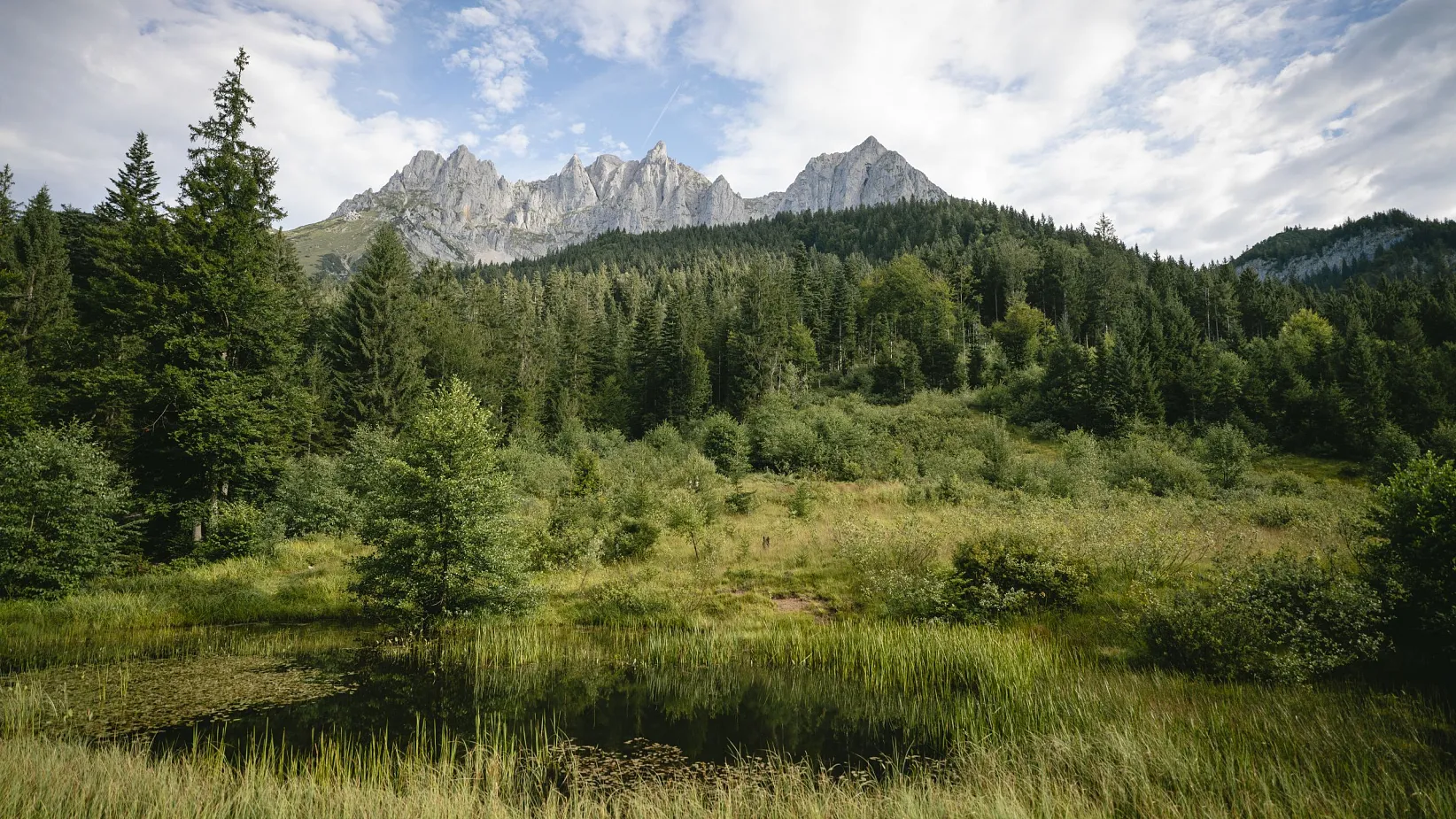
The protected moorland area on the Wilder Kaiser.
What does all this have to do with the Wilder Kaiser?
There are currently 23 Ramsar sites in Austria, one of which is the Wilde Kaiser. Since 2013, this mountain range – which encompasses several types of wetlands – has been protected under the ‘Ramsar Convention’. Furthermore, the entire Kaiser Mountains have been a nature reserve since the 1960s. Even though both conservation agreements stem from human efforts, their purpose is to protect what was there long before humans arrived.
Facts, figures & statistics
- Area: 37.8 km²
- Location: Kufstein, St. Johann in Tirol, Kirchdorf in Tirol, Going, Ellmau, Scheffau
- Elevation: 480–2,344 m
- Ramsar site since 2013

The raised bog in Ellmau is part of the Ramsar Site.

Fauna & Flora
Bog areas dating from the Ice Age
If you look far enough back in time, you’ll come across incredible animals that once inhabited the Wilder Kaiser. Before the last Ice Age, for example, cave bears, cave hyenas, cave lions and reindeer made their home in the ‘Koasa’ – as evidenced by hundreds of bone finds from the Tischhofer Cave. Highly sensitive habitats, such as the Hüttlmoos, Windwehenmoos and the Steinbichlwaldmoor, all of which are Ice Age relics, require comprehensive protection. Whilst these were drained in the 1950s, they have since been restored to their natural state through an initiative by Österreichische Bundesforste AG, as the largest landowner, and with the support of the Province of Tyrol.
The moorland areas are home to numerous animal species specialised to the moor, such as rare dragonfly species, spiders, grasshoppers, beetles, butterflies and over 43 species of bird. You will search in vain for fish, snails and mussels in moors. They lack calcium there. Notable moorland plants include the three carnivorous plants: sundew, butterwort and bladderwort. You’ll also find mountain pines there, along with various heath and bog plants and the occasional dwarf birch.


Moor & More
Along adventure trails through the nature reserve
With great care and attention, moor nature trails have also been laid out and walking routes created. Under the motto "Moor & More", an "outdoor classroom" was created, complete with themed information boards for self-guided excursions. Based on the expert proposal by Univ. Prof. Dr Gert Steiner of the University of Vienna, not only the most important moors but also a significant part of the nature reserve – a karst area – were included in the Ramsar site.
A walk through the moors in Going am Wilden Kaiser